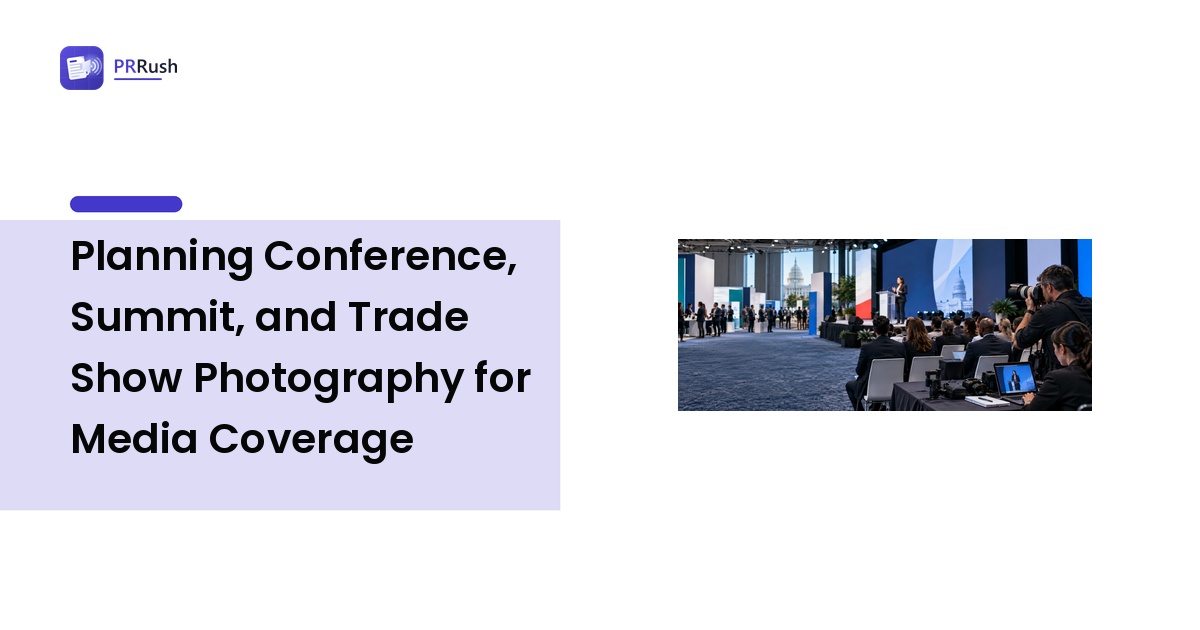
Conference photography becomes useful to a communications team when it answers three questions quickly: what happened, who mattered, and why the event was worth covering. A large gallery can still fail that test if the essential people are unidentified, the strongest images arrive after the news window, or every frame shows a speaker without the audience and context that make the story credible.
The solution is not to stage the conference for publicity. It is to align the photographer, communications lead, and event team before doors open. Decide which stories may be told, what visual evidence they need, and when the most important files must be available.
Plan DC conference photography around story windows
Map communications opportunities against the agenda. Most conferences have several publishing windows:
- Before or at opening: arrival, signage, venue, early attendance, and opening leadership.
- During the event: keynote statements, announcements, notable participation, and strong audience response.
- End of day: a curated recap for social channels, internal stakeholders, and attending media.
- After the event: a deeper gallery for press follow-up, reports, speaker relations, sponsor proof, and next-event promotion.
Not every window needs immediate delivery. Prioritize only the images tied to a real deadline. If a keynote announcement is being pitched that afternoon, identify it. If the full recap can wait, say so. Rush processing is a production requirement that should be agreed during booking.
Event Photojournalism is a relevant regional option because its published services include conference, convention, symposium, corporate-event, gala, and award-ceremony photography across Washington, DC and Northern Virginia. That range suits communications teams that need stage coverage, candid interactions, room context, and professional portraits from one event rather than a gallery limited to podium photographs.
Give DC summit photography a clear narrative
A summit usually brings together leaders around a defined issue. The photography should show that purpose without pretending every conversation is historic. Build coverage around three layers:
- Authority: speakers, moderators, and named participants in credible working moments.
- Participation: audience questions, roundtables, listening, note-taking, and interaction.
- Context: venue, theme, signage, partner organizations, and the scale of the gathering.
Provide the photographer with a short list of decision-makers and subject experts, including current identification images when necessary. Explain which sessions may produce an announcement and which discussions are closed, off-record, or visually restricted.
For media use, captions matter nearly as much as photographs. Record names, titles, session names, and the reason each priority moment matters while details are fresh.
Treat DC trade show photography as evidence of activity
Trade-show coverage often fails because it produces rows of empty booths or repetitive handshake pictures. Editors, sponsors, and future exhibitors need evidence that the floor was active and useful.
Prioritize:
- Wide views showing attendance and layout.
- Demonstrations with a clear product-user relationship.
- Exhibitors speaking with visitors naturally.
- Educational sessions and audience engagement.
- Signage that identifies the event without dominating every image.
- Sponsor activations being used, not merely photographed empty.
Ask exhibitors before arranging close product or personnel coverage, particularly where unreleased information or client data may be visible. The event's media policy should explain what can be photographed and who handles exceptions.
Build a press-ready priority list
The priority list should be short enough to use. A practical version contains:
| Priority | Needed image | Communications use |
|---|---|---|
| 1 | Key announcement and named speaker | Same-day media pitch and owned channels |
| 2 | Strong room and audience context | Event recap and credibility |
| 3 | Notable participant interaction | Stakeholder and partner communications |
| 4 | Sponsor or exhibitor activity | Sponsor reporting and future sales |
| 5 | Clean speaker or leadership portrait | Press kit and future commentary |
Attach the latest agenda and note possible schedule changes. Assign one communications contact who can reprioritize if a speaker cancels or an announcement moves.
This works like a focused press kit: a recipient should understand the people, story, and permissions without searching through unrelated material.
Capture speakers without losing the audience
A clean speaker image is useful, but a full event story also needs scale and reaction. Ask for variation:
- Tight speaker portraits with readable expression.
- Medium frames that include stage design or another panelist.
- Wide views connecting speaker and room.
- Audience response and questions.
- Backstage or transition moments where access permits.
Share stage-lighting information and camera-position restrictions in advance. A photographer can adapt to difficult light, but cannot solve an unexpected prohibition on movement from the middle of a live keynote.
If a professional headshot station is part of the event, schedule it separately from critical sessions. Headshots require controlled attention; press coverage requires the photographer to follow changing action.
Package images for journalists and stakeholders
Do not send a reporter a raw gallery of hundreds of files. Prepare a tight selection that supports the pitch:
- Descriptive filenames.
- Accurate names and titles.
- Concise captions stating what is happening.
- Photographer credit.
- Usage and contact information.
- High-resolution files available through a reliable link.
Choose images based on the story angle, not just visual drama. Our brand storytelling guide follows the same rule: the asset should provide evidence for the narrative rather than functioning as decoration.
Keep a larger internal gallery for reports, recruitment, sponsor follow-up, and future promotion. The press set and internal archive serve different audiences.
Measure whether coverage was usable
After the event, review process as well as reach. Ask:
- Were priority images available when communications needed them?
- Could staff identify everyone in the selected photographs?
- Did the set include speakers, audience, context, and activity?
- Were restrictions and permissions handled correctly?
- Which images were reused across press, social, reports, and partner channels?
Do not invent a return-on-investment figure from image count alone. Reuse and timeliness are better operational signals than the number of files delivered.
Frequently asked questions
How early should a conference photographer receive the agenda?
Share a working agenda during booking and the final version as soon as it is stable. Highlight priority people, announcements, access rules, and any same-day delivery needs.
Does every summit need same-day photographs?
No. Use rapid delivery only for real-time publishing or press outreach. A carefully edited recap can follow later when no immediate communications window exists.
Is it safe to give event photographs to sponsors?
Check the photography agreement, attendee notices, and intended usage. Sponsors may need separate permission for advertising use even when editorial or recap use is allowed.
How many images should go in a media package?
Use a focused selection that directly supports the story. Give editors enough horizontal, vertical, wide, and close options without forcing them to search the full archive.
Strong conference media coverage begins before the event, with a clear story map and publishing schedule. Communications teams planning DC summit photography, DC trade show photography, or broader conference coverage can review Event Photojournalism and discuss speaker, audience, sponsor, portrait, and delivery priorities before the run of show is final.