You have one announcement and a handful of reporters who might cover it. Do you give the whole story to one outlet, or hand it to several under a shared "do not publish before" deadline? People use embargo and exclusive as if they're the same lever. They aren't — and the wrong one can flatten a launch or cost a relationship you'll need next time.
The takeaway up front: the whole embargo vs exclusive decision comes down to a single tradeoff — an exclusive trades reach for depth and commitment; an embargo trades depth for coordinated reach. Offer an exclusive when one outlet's audience and analysis matter more than total pickup and you can live with no one else covering it. Offer an embargo when you want several outlets publishing the same hour and the story is strong enough that journalists will respect a deadline. Most announcements need neither — but when one does, choosing right is the difference between a wave of coverage and a single grudging mention.
What each term actually means
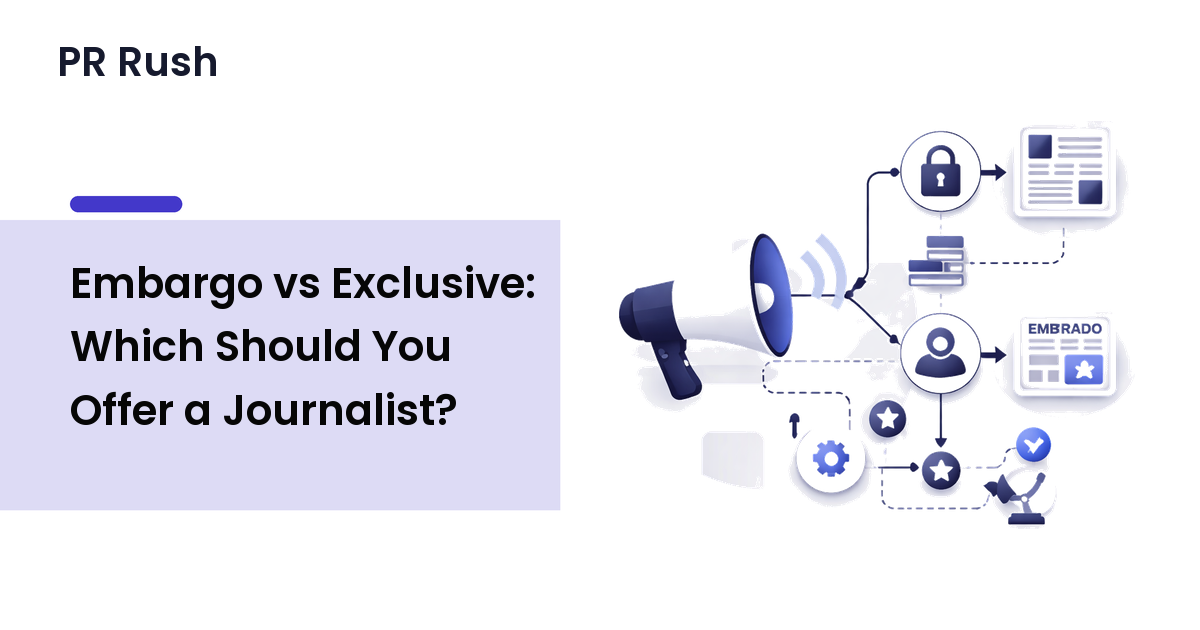
A media exclusive gives the story to one outlet and no one else, usually ahead of any public announcement. In exchange for sole access, that reporter typically commits to deeper treatment — more space, an interview, real analysis — and gets to be first and only. The currency is uniqueness: their version is the only version, which is why a good outlet will invest in it.
A press embargo gives the story to several journalists at once, ahead of time, on the condition that none publish before an agreed date and time. Everyone gets the same material and head start. The currency isn't uniqueness — it's preparation and synchronization: reporters get time to write something considered, and you get a coordinated burst of coverage at the moment you choose.
When an exclusive is the right call
An exclusive wins when depth and the right audience beat raw volume. Choose it when:
- One outlet reaches the exact people you care about. A single deep feature in the publication your buyers, investors, or partners read beats ten thin reposts nobody influential sees.
- The story rewards analysis, not just announcement. A strategy shift, a contrarian data finding, or a nuanced launch lands better as one considered piece than a dozen rushed summaries.
- You can genuinely accept no other coverage. This is the test most people skip. An exclusive means everyone else may pass, because the story is no longer theirs to break. If that would count as a failure, don't offer one.
The cost is real: you're betting your whole announcement on one outlet. If they pass or bury it, you've spent your news with little left — so an exclusive belongs with a reporter you trust, not a cold name you hope will bite.
When an embargo is the right call
An embargo wins when coordinated reach beats any single placement. Choose it when:
- You want simultaneous coverage across multiple outlets. A funding round, major launch, or research report often plays best as a wave — several pieces landing the same hour, reinforcing each other.
- Reporters need lead time to do it justice. Complex news — data to verify, a product to test, executives to interview — benefits from hours or days to prepare before the clock strikes.
- Timing genuinely matters. Tying publication to a specific moment — a keynote, a market open, a coordinated reveal — is exactly what an embargo is built for.
The cost is coordination risk. The more people hold your story early, the higher the chance someone breaks the embargo — and once one outlet publishes, your timing collapses. Embargoes work in proportion to how strong the story is and how few and trusted the recipients are.
The mistakes that blow up trust
Both tools fail the same way: by treating journalists as distribution channels instead of people. A few traps do most of the damage.
The "exclusive" that isn't. Promising a story as exclusive while quietly pitching three other reporters is the fastest way to torch a relationship. Journalists talk, and the moment one finds your "exclusive" ran elsewhere, they stop trusting your offers. If you say exclusive, it must be exclusive.
The embargo nobody agreed to. An embargo is an agreement, not a command you staple to an email. Blasting "EMBARGOED UNTIL TUESDAY" at reporters who never accepted it binds no one — many treat unrequested material as fair game. Confirm agreement before you send details, and reserve embargoes for news where timing genuinely matters.
Vague terms. "Embargoed until next week," or a deadline with no time zone, invites a break — ambiguity gets read in the reporter's favor. State the exact date, time, and time zone, and when one outlet does jump early, lift the embargo for everyone immediately so those who honored it aren't penalized.
Every one of these is a relationship decision dressed up as a logistics one — how you treat journalists here matters more than any single launch. See the media relations guide for the longer game these choices sit inside.
How to run either one cleanly
The mechanics are simple; the discipline is everything.
For an exclusive: Pick the one outlet first — the reporter whose audience and beat fit best — offer it plainly with a window to decide, and pitch no one else until they pass. If they decline, then go to the next outlet or go broad.
For an embargo: Get a yes to the terms before sending materials, brief the shortest sensible list of trusted reporters, put the date, time, and time zone in writing, and stay reachable as the clock approaches — ready to lift it early if it breaks anywhere.
The through-line for both: be specific, and keep your word.
FAQ
What is a press embargo, and how is it different from an exclusive?
A press embargo gives several journalists your story early on the agreed condition that none publish before a set date and time — so the value is preparation and a synchronized release. A media exclusive gives the whole story to one outlet and no one else, trading reach for that outlet's depth and commitment. An embargo coordinates many; an exclusive concentrates on one.
Do I even need an embargo or an exclusive for my announcement?
Usually not — most news can simply be sent to interested reporters when it's ready. Reach for an exclusive only when one outlet's depth and audience matter more than total pickup and you can accept no other coverage; reach for an embargo only when you need several outlets publishing at a coordinated moment and the story can hold a deadline.
Can I offer a story as exclusive and also embargo it?
Yes — an "exclusive-then-embargo": one outlet publishes first at the embargo time, then the story opens to everyone else. The lead outlet gets the "broke it first" credit while others still cover it. It's the most relationship-heavy option, so reserve it for significant news and a reporter you trust.
What happens when an embargo is broken?
Once an embargo is broken by any outlet, it's effectively over — so lift it for everyone right away, because the reporters who honored it shouldn't be punished for someone else's jump. Don't retaliate publicly; note who broke it and weigh that next time. A calm, fair response protects your standing with the outlets who played straight.
How do I keep an embargo from being broken in the first place?
Brief the smallest sensible list of trusted reporters, confirm each agrees before you send details, and state the exact date, time, and time zone in writing. The fewer people holding the story early and the clearer the terms, the less likely anyone breaks it.
Decide the deal, then protect the relationship
Embargo or exclusive isn't a coin flip — it's a read on what your story needs. Want one deep piece in the publication that matters, and can live with no other coverage? Offer an exclusive, to one reporter, and tell no one else. Want a coordinated wave at a moment you choose, with a story strong enough to hold a deadline? Run an embargo, on a short trusted list, with terms stated to the minute.
The deeper point: every one of these choices is about the reporters you'll need again. Treat the deal as a promise and honor it exactly, and you build the standing that makes the next story easier to place. Start with the fundamentals at prrush.com.