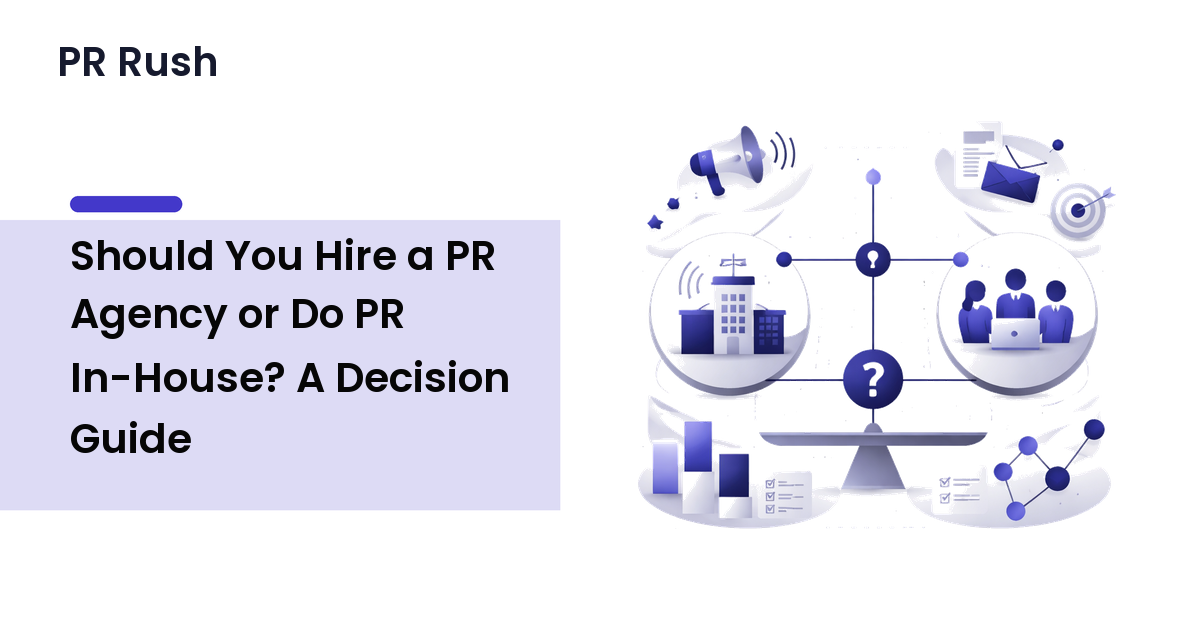
A founder gets coverage envy, books three agency calls, and walks away with proposals for a hefty monthly retainer and a promise of "media relationships." The instinct is to sign — surely professionals will land the press you can't. Slow down. An agency is sometimes exactly right, and sometimes a way to rent a contact list you could build yourself for free.
The takeaway up front: the PR agency vs in-house question isn't about who's "better" at PR — it's about what you're actually buying, and whether you can get it cheaper another way. When you ask should I hire a PR agency, you're really asking whether you lack one of three things agencies sell: relationships, bandwidth, or judgment. Name the gap and the answer usually becomes obvious. For many early-stage teams with a real story and a few hours a week, the honest answer is to do it in-house first.
What you're actually paying for
Strip away the decks and a retainer buys some mix of three things. Naming yours is most of the decision.
- Relationships. Established journalist contacts and the trust that makes a pitch get read — genuinely hard to buy elsewhere, and the most often overstated.
- Bandwidth. People to build media lists, write pitches, chase follow-ups, manage embargoes, and handle the logistics. The most common reason an agency pays off.
- Judgment. Knowing which angle is newsworthy, what's press-worthy versus a blog post, when to time an announcement, and how to read a journalist's "no." Teachable, but a good agency arrives with it on day one.
Write down which you lack. "All three and no time" points to an agency. "I have the story and the judgment, I just hate the busywork" points to a freelancer or one hire — not a retainer.
The contact-list myth
The single most oversold agency benefit is "media relationships." It's real, but narrower than the pitch implies — and the assumption most likely to waste your money.
A relationship helps only when it's relevant to your beat — deep contacts in consumer lifestyle do little for a B2B infrastructure startup. It's also personal, not corporate: relationships belong to the individual publicist, so if that person leaves or hands you to a junior, the contacts you paid for can walk out the door. And the list itself isn't the moat. Bylines, beats, and often contact details are largely public if you do the legwork; what an agency really adds is standing — a reporter answers faster because past pitches were relevant, and you can build that yourself with consistency. So ask the blunt version: named, recent contacts on my specific beat — or a generic media database I could license for a fraction of the retainer?
When to hire a PR firm: where an agency earns its retainer
Some situations make outsourcing the right call, not a shortcut. You have a real reason to hire when any of these is true:
- You have zero bandwidth and a time-sensitive moment — a funding round, a launch, a milestone — and no one in-house can run sustained outreach without dropping their day job.
- You're entering a market or geography you don't know, and a specialist agency genuinely covers that beat with named, current contacts (verify this).
- The stakes are high and the downside is real — a crisis, a sensitive announcement, regulatory scrutiny — where experienced judgment is worth paying for.
- You need consistent volume over months, not one push, and an in-house hire would cost more in salary and ramp-up than the retainer.
The pattern: agencies earn their keep on bandwidth and judgment under pressure, far more than on the contact list. "I want someone to make press happen for me" isn't a reason — that's the coverage-envy trap, and it ends in an expensive retainer with thin results.
When in-house PR (or a single hire) wins
For a large share of early-stage and lean teams, doing PR yourself isn't the budget compromise — it's the better decision. In-house PR tends to win when:
- You have a genuine story and the founder is a credible spokesperson. Journalists often prefer hearing directly from the founder, so your access and authenticity are an advantage an agency can't replicate.
- Your need is occasional, not constant. A couple of announcements a year doesn't justify a monthly retainer. Pitch the moments that matter and stay quiet in between.
- You're pre-product-market-fit and need to learn the muscle. Outsource PR too early and you never develop the instinct for what's newsworthy about your own company — and you'll lean on the agency forever.
- Budget is tight and the math doesn't work. A retainer that buys a few placements can cost more than those placements are worth.
The in-house path has one prerequisite: someone must own it and protect a few hours a week, because PR done "whenever there's time" gets done never. If no one will truly own those hours, that's a real reason to hire — better deliberately than to run in-house PR only on paper. But the skills — building a focused list, writing a pitch, timing a send, following up — are learnable and compounding, and the relationships you build are yours, not rented. For the full workflow, start with the media relations guide.
A simple test before you commit
You don't have to guess — run a small experiment first.
- Try one real pitch cycle yourself. Pick one genuine story, build a list of ten relevant journalists, write a tailored pitch, send it, and follow up once. Replies mean you can do this; silence often means the story is weak, not that you need an agency.
- If you shortlist agencies, interview for specifics. Ask for named, recent contacts on your beat; ask who does the work day-to-day, you or a junior; ask what happens if results are thin. Vague answers are an answer.
- Price it against the alternative — a part-time hire, a freelancer for the busywork, or a media-database subscription plus your time. Pick the cheapest option that closes your gap.
FAQ
Is a PR agency worth it for a startup?
Sometimes, not by default. It's worth it when you have a real story, a time-sensitive moment, and no bandwidth to run sustained outreach in-house — or when the stakes are high enough that experienced judgment matters. It's usually not worth it when your assets are a good story and founder access and your need is occasional. Test one pitch cycle yourself before committing.
How much does a PR agency cost?
It varies widely by scope, seniority, and market, so treat any single figure with suspicion. The useful frame is comparison: weigh the retainer against a part-time hire, a freelancer for the logistics, or a media-list subscription plus your time — and against the coverage you'd realistically earn, not the hope of going viral.
Can I do PR myself with no media contacts?
Yes — most contacts start cold. Beats, bylines, and often contact details are largely public, so you can build a focused, relevant list yourself. What you can't shortcut is standing: reporters respond faster once your past pitches prove relevant and concise. That trust compounds, and unlike an agency's relationships, it stays yours.
What's the difference between a PR agency and a freelancer?
An agency provides a team, broader capacity, and an established roster of contacts at a higher, ongoing cost. A freelance publicist is usually cheaper and more flexible, often handling specific projects or the outreach logistics while you keep ownership of the story. If your gap is bandwidth rather than relationships, a freelancer often closes it for far less.
Should I hire an agency just to get media relationships?
Be careful — this is the most overpaid reason to hire. Relationships only help if they're current and on your beat, and they belong to the individual publicist, not the agency. Confirm named, recent contacts who cover your category. If all they offer is a generic database, license that yourself for a fraction of the retainer and build the relationships directly.
Next step
Before you sign anything, get specific about what you'd actually be buying: relationships, bandwidth, or judgment. Decide an agency is still right and you'll negotiate from knowledge — named contacts on your beat, clarity on who does the work, and a price that beats the in-house alternative. The goal isn't to avoid agencies; it's to never pay a retainer for a job you could already do. Build the muscle first at prrush.com.