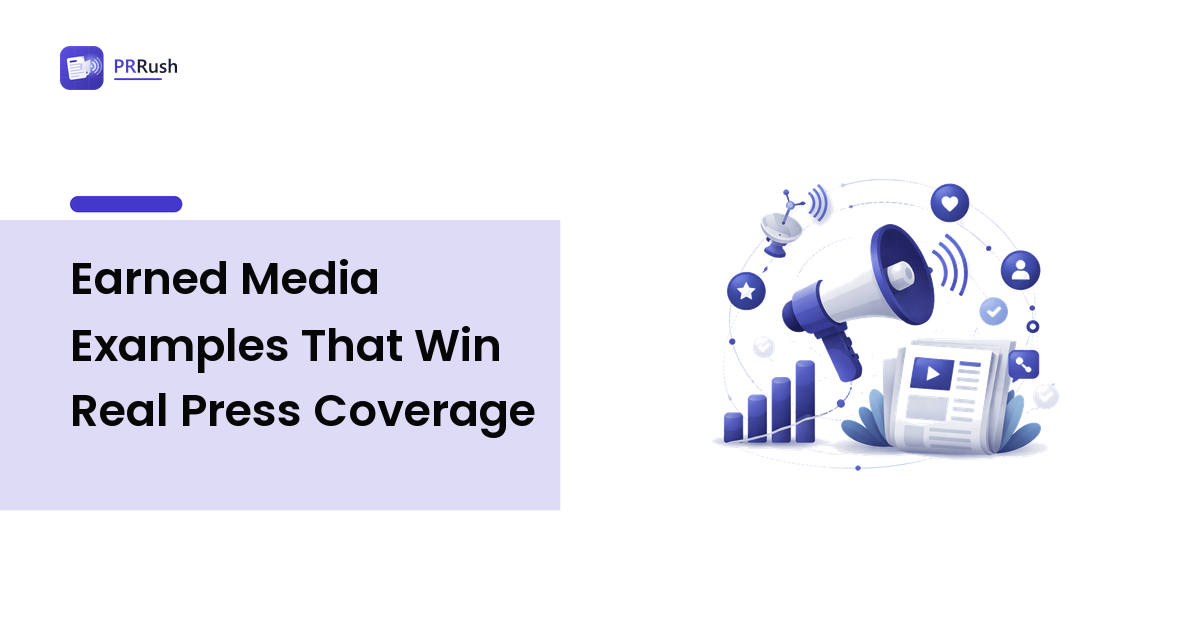
Earned media is coverage you did not pay for and did not publish yourself — a journalist writes about you, a customer reviews you, an analyst cites you, someone shares your work. It is the most credible visibility a brand can get, precisely because a third party chose to give it. The best way to understand it is not through a definition but through concrete earned media examples: the specific things brands did that made other people talk about them. This guide walks through real, recognizable examples of earned media, then shows the outreach tools and best practices that turn a one-off mention into a repeatable system.
The short version: earned media examples fall into a handful of repeatable patterns — press coverage, expert commentary, original data, product-led moments, reviews, and user-generated buzz. None of them are luck. Each is the visible result of something deliberate. Below, we break down the patterns, name campaigns that fit each one, and cover the tools and practices that make them happen more than once.
What Counts as Earned Media (and What Doesn't)
Marketers usually split visibility into three buckets. Owned media is what you control — your blog, site, and email list. Paid media is what you buy — ads, sponsorships, and boosted posts. Earned media is everything a third party gives you for free because they found you worth mentioning. A magazine feature, a podcast interview, a Google review, a Reddit thread praising your product, an industry award — all earned.
The line that trips people up is anything you paid for. A "sponsored post," a paid placement, or coverage promised in exchange for money is paid media wearing an earned costume — and chasing it is a trap. Real earned media is given, not bought, which is exactly why audiences trust it. The examples below all clear that bar.
Earned Media Examples by Type
Rather than a random list, group the examples by the mechanism that earned them. Once you see the pattern, you can reproduce it.
Press Coverage From a Newsworthy Announcement
The classic example: a company announces something genuinely new — a funding round, a category-defining product, a notable hire, a milestone — and reporters who cover that beat write about it. When a startup's Series B gets covered in TechCrunch, that article is earned media. The announcement was deliberate; the coverage was earned by making it relevant and timely to the right journalists.
Original Data and Research
Publishing a survey, index, or analysis that reporters can cite is one of the most reliable earned media examples there is. Think of the annual "state of" reports that get quoted across an industry, or a fintech's spending-trends study that ends up in a business section. Journalists need fresh data; a brand that supplies it becomes the cited source. The coverage is earned because the data was genuinely useful, not because anyone paid for the mention.
Expert Commentary and Source Requests
When a journalist needs a quote from someone who knows a topic, and your spokesperson provides a sharp, timely one, you earn a mention — sometimes a full profile. Responding to reporter queries (through services like Qwoted, Featured, or Help a B2B Writer) is a steady, unglamorous source of earned media. The example here is any "according to [your expert]" line in an article you did not pay for.
Product-Led and Viral Moments
Some earned media comes from the product or campaign itself being remarkable. Spotify Wrapped is a standout example: every December, users voluntarily share their listening data, and the press covers the phenomenon — free, at massive scale, year after year. Dove's "Real Beauty" work is another, earning coverage and conversation because the idea itself was talk-worthy. These are earned because audiences chose to spread them.
Reviews, Word of Mouth, and User-Generated Content
Not all earned media runs through the press. A glowing G2 review, a viral TikTok from a customer, an unprompted recommendation in a niche community, or a wave of user-generated posts around a launch are all earned. They are harder to engineer but often more persuasive, because they come from peers rather than publications.
What the Best Earned Media Campaigns Have in Common
Look across the strongest campaigns of the last few years and the same traits recur, regardless of the year on the calendar. First, they give people a reason to talk — a genuine hook, not a slogan. Second, they are relevant to a specific audience and the journalists who serve it, rather than aimed at everyone. Third, they hand the media something ready to use: clean data, a strong quote, a clear narrative, real visuals. Fourth, they are timed to a moment the audience already cares about.
The best earned media campaigns are not the ones with the biggest budgets — they are the ones built around an idea worth repeating. If you are evaluating your own plan, ask whether a stranger would mention it to a colleague unprompted. If not, it is unlikely to earn anything, no matter how many contacts you pitch. Earned media rewards substance over spend, which is why a small team can beat a large one.
Email Outreach Tools That Help You Earn Coverage
Great examples still need distribution: the right journalist has to see your story. A few categories of email outreach tools make that repeatable, and the right pick depends on your stage and budget.
- Media databases (Muck Rack, Prowly, Roxhill) help you find journalists by beat and manage a media list. Choose these when your bottleneck is who to pitch and you need current contact data.
- Journalist-request platforms (Qwoted, Featured, Help a B2B Writer) surface reporters actively seeking sources. Pick these when your strength is expert commentary and you want inbound-style opportunities.
- Outreach and sequencing tools (Pitchbox, or general-purpose senders like Instantly and Lemlist) manage personalized follow-ups at modest scale. Use these when your bottleneck is consistency of follow-up, not finding names.
- A plain inbox with a tracker (Gmail plus a spreadsheet) is genuinely the best starting point for most small teams, because a hand-built list of 30 well-matched reporters beats any tool used to blast a bad one.
The Best Email Outreach Tools for Small PR Teams
If you are choosing among the best email outreach tools, rank them by the problem you actually have, not by feature count. For finding and organizing contacts, a media database earns its cost once you are pitching regularly. For landing expert quotes, a journalist-request platform delivers faster than any cold outreach. For a lean team just starting, skip the paid stack entirely: a focused inbox and a real media list will out-earn expensive software used carelessly. The tool never earns the coverage — the relevance and the relationship do. For the underlying craft of building those relationships, see our media relations guide.
Earned Media Best Practices
Turning these examples into your own results comes down to a few durable best practices:
- Lead with the story, not the ask. Journalists cover news, not favors. Make the newsworthy element obvious in the first line.
- Pitch the right person, narrowly. A small, researched list beats a mass blast every time — relevance is what earns a reply.
- Give them something ready to run. Data, a quote, visuals, and a clear angle lower the effort of covering you.
- Never fabricate or inflate. Invented stats and guaranteed-coverage promises destroy the trust earned media depends on.
- Play the long game. Be a useful, reliable source before you need a favor, and one placement compounds into many.
Earned media examples look effortless from the outside, but each one is the visible tip of deliberate work — a real hook, the right journalist, and something worth talking about. Copy the pattern, not the surface, and you can earn coverage on purpose rather than by accident.